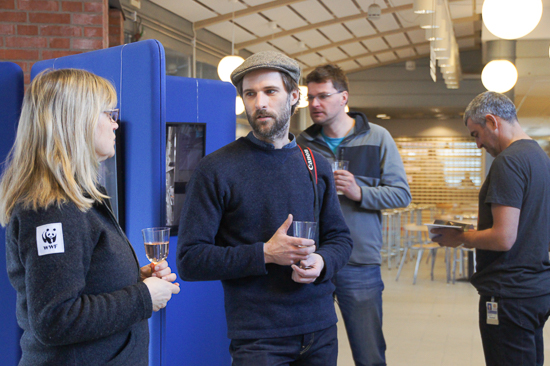
On Thursday 15/3 there was a ”Release Party” and photo exhibition of CAnMove’s e-book in foyer of the (mer …)


Biologiska institutionen | Lunds universitet
On Thursday 15/3 there was a ”Release Party” and photo exhibition of CAnMove’s e-book in foyer of the (mer …)
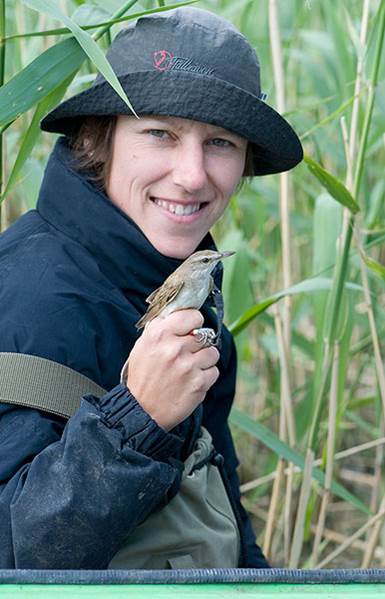
Hi everyone!
I am now back in Lund after a three year postdoc in Trondheim at NTNU, where I worked on evolvability of sexual dimorphism and consequences of sex on pace-of-life syndromes. I am an evolutionary ecologist with a focus on the genetic architecture and evolutionary dynamics of wild animal populations.
I will now continue working on my favourite study system, the great reed warblers at Lake Kvismaren, and dig into questions on trade-offs between immunity and lifespan in combination with sexual conflicts. I will be affiliated as a researcher in Dennis Hasselquist’s and Bengt Hansson’s research groups.
In my spare time, I like to listen to music, hang out with my human and non-human friends and grow my own food.
Looking forward to meeting you all!
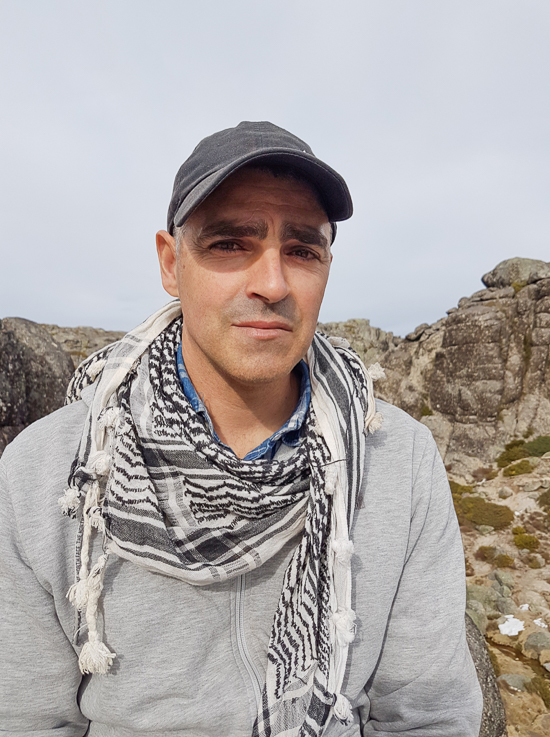
Hi everyone!
After being a visiting post-doc for nine years, and subsequently teaching and working on several projects at Lund University, I am by now familiar to most people in this department! However, I’m starting a full-time contract as a researcher, and so let me present myself here again.
I’m Júlio Manuel Malha Simões Neto, a researcher originally from Portugal, but with a DPhil awarded by Oxford University back in 2004. I have a broad interest in behavioural ecology and evolutionary biology, and work mostly on natural populations of marshland passerines. My main current projects focus on local adaptation and speciation in Reed Buntings, and on the migration and conservation of Aquatic Warblers. I often use multidisciplinary approaches such as genetic, acoustic and stable isotope analyses, as well as intensive field work involving bird ringing, nest finding etc. Otherwise, I’m a member of the Aquatic Warbler Conservation Team, a subject editor of Journal of Avian Biology, and maintain a constant-effort ringing site in Krankesjön!
During the next 1.5 years, I will study the temporal and geographical variation of the relationship between malaria infections and the variation and expression of immunity (MHC) genes in natural populations of House Sparrows. This is part of the ERC-funded project given to Helena Westerdahl, which focuses on host-parasite co-evolution. Hence, I’ll be available for some more time to interact with you all, and undertake fruitful collaborations!
Idag blev Stefan Pierzynowski avtackad då hans sista arbetsdag var igår. Sedan 1985 har Stefan jobbat på (mer …)
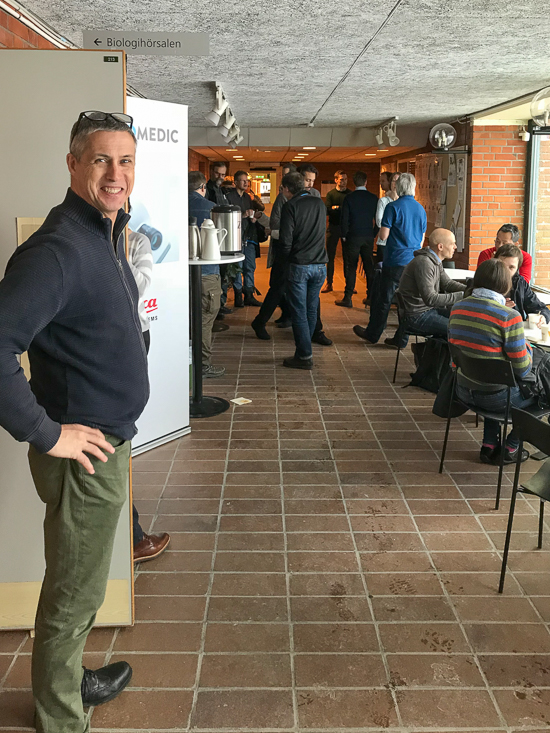
Yesterday the department’s new confocal and light sheet microscope, the Leica TCS SP8 DLS, was inaugurated at a highly successful launch event held in (mer …)
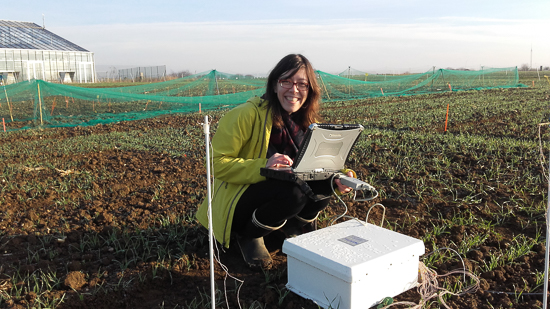
Hi everyone,
I am Anne-Lise, a third-year Ph.D. student at the French National Institute for Agricultural Research visiting Erik Svensson’s group for three months (March–May 2018).
My research falls at the interface of epidemiology and ecology with a long-standing interest in phenotypic variation among individuals and its consequences on population- and community-level processes. I have investigated this topic on a variety of organisms including aphids, plants and fungal pathogens during my previous research positions (as a part of my bachelor and master programs that I conducted between France and the Netherlands).
I am currently studying responses and adaptation of plant pathogen populations to changes in thermal conditions at various spatio-temporal scales combining field, greenhouse and lab experiments.
At Lund University with Erik, I will further explore how thermal changes and population dynamics jointly influence patterns of phenotypic variations using a theory-driven modelling approach.
I am really delighted to be here and I look forward to the upcoming months working with all of you!
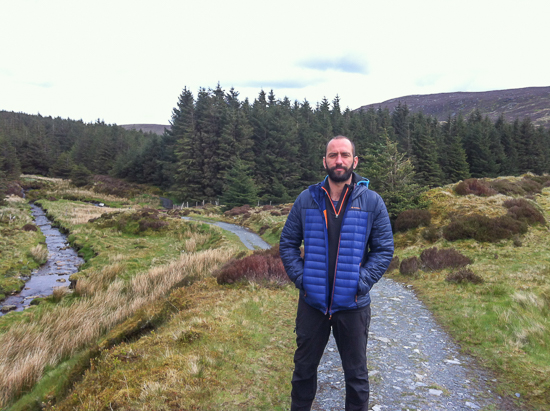
My name is Miguel Gómez, I did my PhD in intra- and interspecific interactions, looking at how they affect reproductive behaviours such as mate choice and sexual conflict and their evolutionary implications. Recently, I joined Erik Svensson group to study the effect of interspecific interactions allowing a guild of ecologically similar species of damselflies to coexist. Odonates are a really good system to study sexual selection, and I’m looking forward to investigate the role of interspecific reproductive interference and sexual harassment in species coexistence.
Ideon Gateway bathed in the sun when GENECO held their winter (mer …)
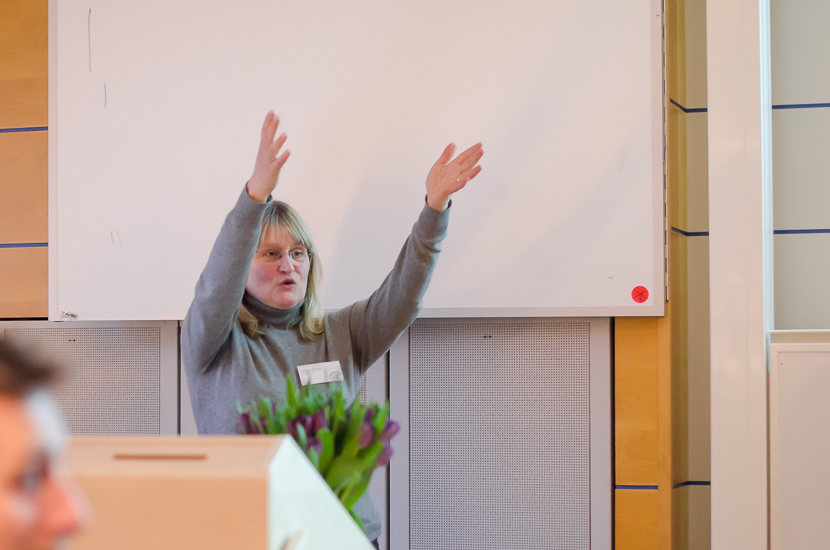
Yesterday the Linné project CAnMove (Centre for Animal Movement) celebrated its first 10 years with a conference for present and former (mer …)
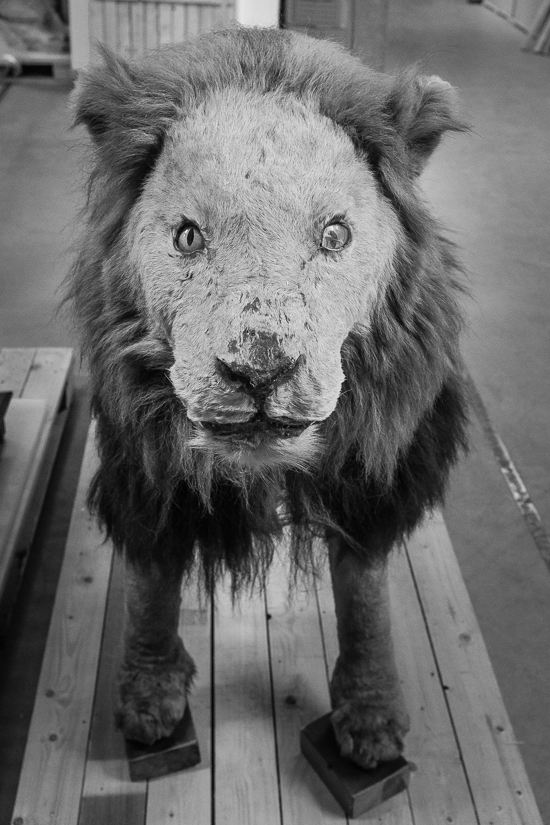
Today SACT arranged a seminar to show the wonders of our Biology Museum. In a packed Blue Hall Niklas Wahlberg took the opportunity to show how researchers may use (mer …)
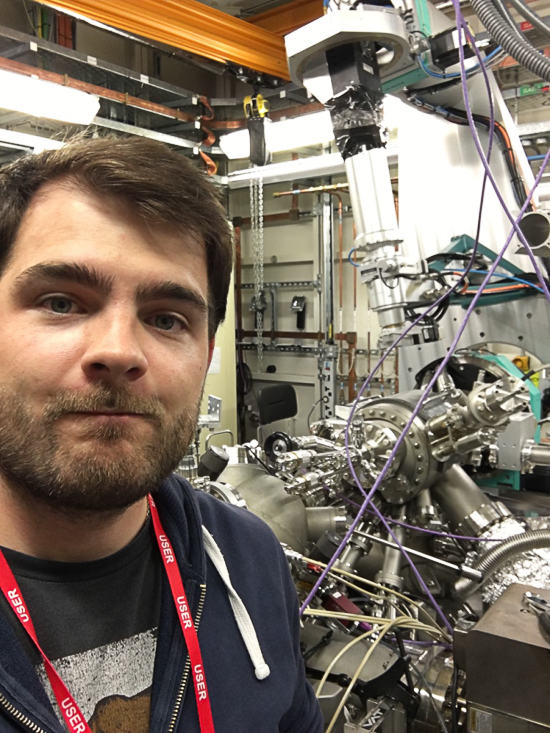
Hej alla!
My name is Robin Delhom and I just started a two year contract as ‘Forskare’ at the Molecular Cell Biology Unit in a collaboration project with the Lund Protein Production Platform (LP3) and the European Spallation Source ERIC (ESS).
I am French, 28, have done a master degree in organic chemistry followed by a PhD in membrane biophysics and here I am now in the Department of Biology of Lund University!
I defended my PhD project, co-financed by the Institut Laue-Langevin (ILL) and the ESS, last December in Grenoble where I was mainly working for the past three years. The objective, among others, was to develop a relevant model membrane for neutron studies which I then used to investigate the mechanism of action of Amphotericin B, a powerful anti-fungal drug. The multidisciplinary project and its relationship with ESS allowed me to work in a lot of different environments and brought me towards Sweden, LU and LP3.
My contribution here and now is to develop, investigate and make use of lipid membranes extracted from microorganisms with neutron scattering techniques in order to understand biological processes occurring at the edge of living cells.
Thus, if you are intrigued or want to know more about lipids/membranes, neutrons or else, please come along! You can find me in the office 141 of Biology building A or contact me at robin.delhom@biol.lu.se
Ses snart!
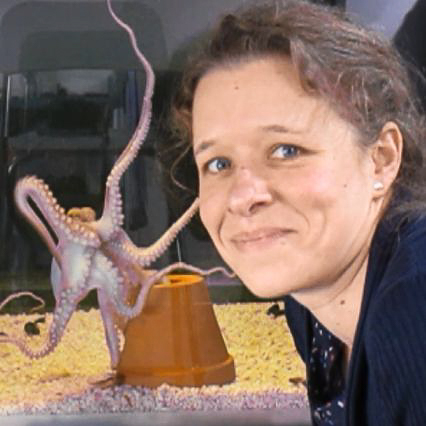
My name is Frederike Hanke, originally I am from Germany where I have studied and worked in Freiburg, Bochum and Rostock. Just recently I have joined Almut Kelber’s group to investigate if octopus is able to perceive colors. Generally I am very interested in the visual and cognitive abilities of (semi)aquatic animals. For many years, I investigated the visual abilities of harbor seals. Since 2012, I have been working with octopus, too. These animals are fascinating creatures that seem to observe me as soon as I enter the room with the aquaria. They easily learn experimental procedure. But can I make them discriminate in general and discriminate stimuli on the basis of hue specifically?
Kommentarer